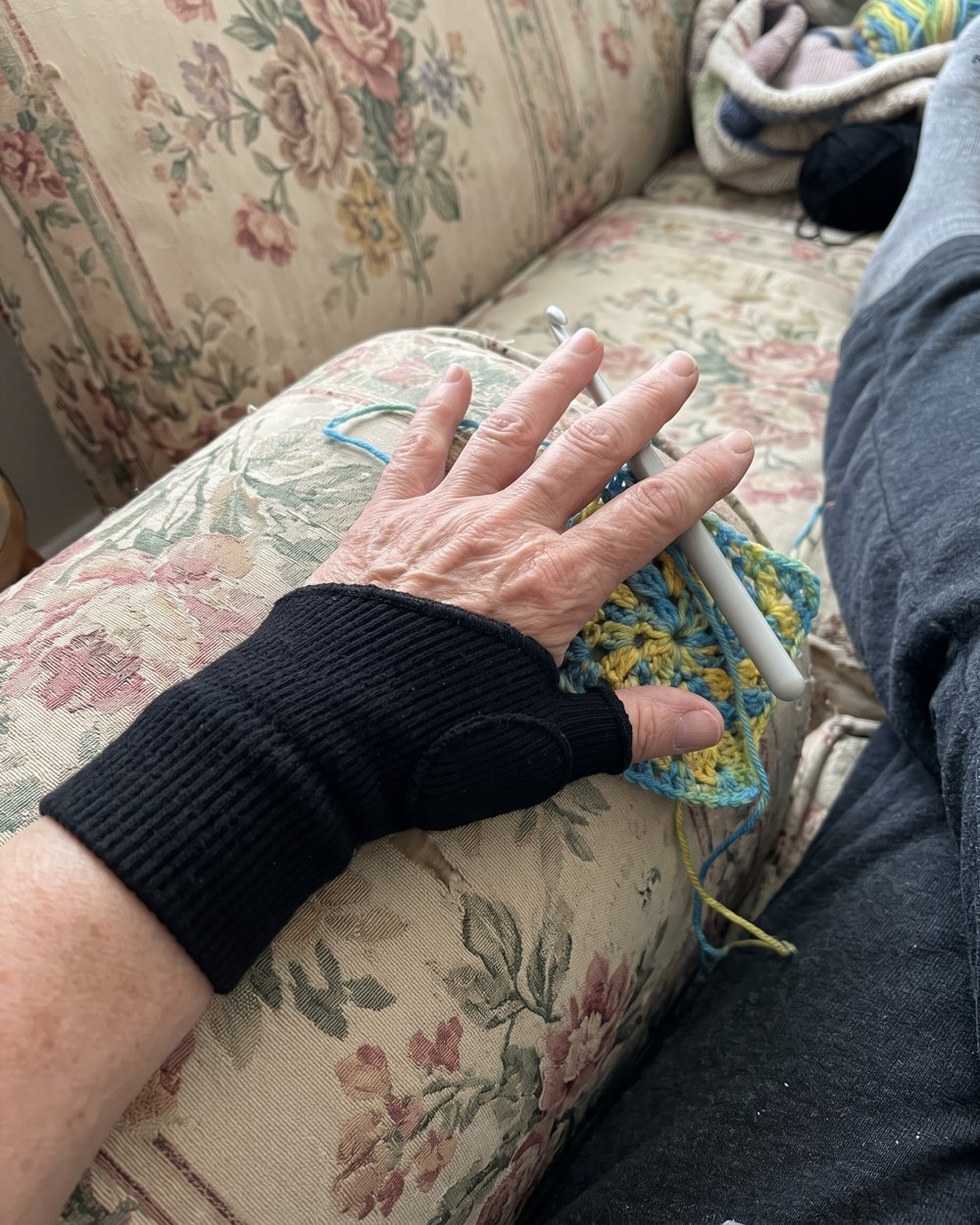
I'm 67. Three Doctors Told Me to Quit Knitting. A Hand Therapist Finally Explained Why the Pain Kept Coming Back.

If the base of your thumb aches every time you knit, and someone told you to "find another hobby," please read this first. It's the explanation I wish someone had given me a year ago.

The six-minute appointment that almost ended fifty years of knitting
My doctor told me to stop knitting on a Tuesday in January.
The appointment lasted six minutes. I know because I watched the clock on the wall behind him. He looked at my X-ray, not at my hands. He said "basal thumb arthritis" and "avoid aggravating activities."
I told him, "Doctor, other than knitting and crochet, I don't do anything with my hands. And I've knit for fifty years without a single problem."
He said, "Then you may need to consider other hobbies."
He handed me a rehab pamphlet with a golfer on the cover. Nothing inside about needlework. Nothing about the tiny, repeated motion my thumb makes a thousand times an hour.
It was written for golfers and for people who hurt their hands lifting boxes. Not for knitters.
He never asked to see how I hold my needles. Not once.
I drove home and sat in the car in my driveway for ten minutes before I could go inside. I have never felt so dismissed in my life.
Knitting isn't a hobby you just swap out
I'm sixty-seven. Knitting got me through my sister's death, the end of my marriage, and forty years of Christmases. Every one of my grandchildren came home from the hospital in a blanket I made.
It isn't something you change like a TV channel. And he gave it six minutes.
So I did what he said. I put the needles in the closet. The basket of yarn by my chair went to the basement.
My evenings got very quiet.

I tried every brace I could find. None of them were made for knitting.
The rigid thumb splint from the pharmacy. It locked my whole thumb in place. I couldn't hold a needle at all. It was made for someone who jammed their thumb in a fall, not for the way a knitter's thumb moves.
The compression gloves. They squeezed my fingers while the base of my thumb, the joint that was the actual problem, had nothing around it. They were made for general arthritis. Not for knitters.
The soft wrap from Amazon. It felt nice, but it didn't stop the bones from moving. It was made for opening jars. Not for working a thin needle hundreds of times a minute. The seam split in the second week.
Three braces. Not one of them designed for knitting.
Because knitting isn't like gripping a golf club, typing, or opening a jar. The thumb motion in knitting is small, precise, and endlessly repeated, and no other activity really copies it. Nobody had designed anything for it.
Then a friend told me about a hand therapist who works with crafters
In March my friend Linda, from my Thursday knitting group, told me about her.
"She asked me to show her how I hold my crochet hook," Linda said. "No doctor has ever done that."
Her name was Diane. Before she even looked at my X-ray, she put a pair of needles in my hands and asked me to show her how I knit.
She watched the base of my thumb. She asked me to pinch her finger. The click came right away. She could feel the bones shift under her fingertips.
Then she said two words.
"It's sliding."

What no doctor explained: the joint is sliding
She explained it simply.
At the base of your thumb there's a small joint that's supposed to stay put. After forty years of knitting, the tissue that holds it in place had gotten loose. So every time I worked a stitch, the joint slid. The bones shifted against each other.
That's the click. That's the dull ache. That's the pain.
The joint is sliding. That's the whole problem.
And the second she said it, everything else finally made sense:
Rest didn't last because the tissue was still loose. On the first stitch back, the joint slid again.
Cortisone wore off because it brings down the swelling, but it doesn't stop the sliding. One evening of knitting and the ache was back.
Every "fix" I'd been given treated the symptom. Not one of them held the joint.
I'd spent a year thinking my hands were simply wearing out. Nobody had told me the pain kept coming back for a reason.
Why none of those braces ever stood a chance
Then Diane said the sentence that changed everything.
"Even if those braces sat in exactly the right spot, none of them were designed for the way a knitter's thumb actually moves."
The knitting motion is gentle, small, and repeated over and over, in a way no other activity copies. A brace built for a golfer's grip is useless to a knitter. The motion is different. So the support has to be different too.
She gave me a thumb stabilizer made specifically for needlework. Not for athletes. Not for typists. For the way a knitter's thumb really needs to move.
It wraps only the base of the thumb. It holds that sliding joint steady. It doesn't lock anything. Your thumb keeps working. Your fingers stay free.
- Rigid splints hold the joint, but they kill the movement.
- Soft wraps allow the movement, but they don't hold the joint.
This does both, because it was designed around the motion knitters actually make.
"If the joint stops sliding," she said, "the clicking stops. The pain stops. That's it."
If your thumb clicks and aches at the base when you knit, this is the stabilizer designed for the way your hands really move.
See the Thumb Stabilizer for Knitters →

The first night I wore it
I came home. I put it on. I picked up my needles. I worked the first stitch. I pulled the yarn through.
No click.
At twenty minutes I could still feel the yarn. I could control my tension. Everything moved the way it should, but the joint didn't slide.
At forty-five minutes I was knitting the way I knit before any of this started.
I knit for an hour and twenty minutes that night.
When I stopped, I wasn't happy. I was furious.
Because three doctors gave me eighteen minutes between them and told me to quit. One hand therapist gave me forty-five, watched how my thumb actually moves, and handed me something designed for the way my hands really work.
Not a golfer's hands. Not a typist's hands. A knitter's hands.
I knit every evening again. The basket is back next to my chair. The pain's gone. The clicking's gone. The joint doesn't slide, because something finally holds it in place during the exact motion that made it slide.
I canceled my follow-up with the orthopedist. The one with the golfer pamphlet.

If your doctor told you to stop knitting, read this part
If your doctor told you to stop knitting because of your thumb, there's a good chance the joint is sliding. Nothing designed for golfers or typists is going to stop that. Those products were never built for the knitting motion.
When a brace is designed for the way a knitter's thumb moves, and holds the joint steady through the whole motion without getting in the way, the sliding stops.
Three doctors told me it was over. A hand therapist, and a brace designed for my actual hands, showed me it wasn't.
See the Thumb Stabilizer for Knitters → 60-day money-back guarantee. If it doesn't make knitting more comfortable, just send it back.